

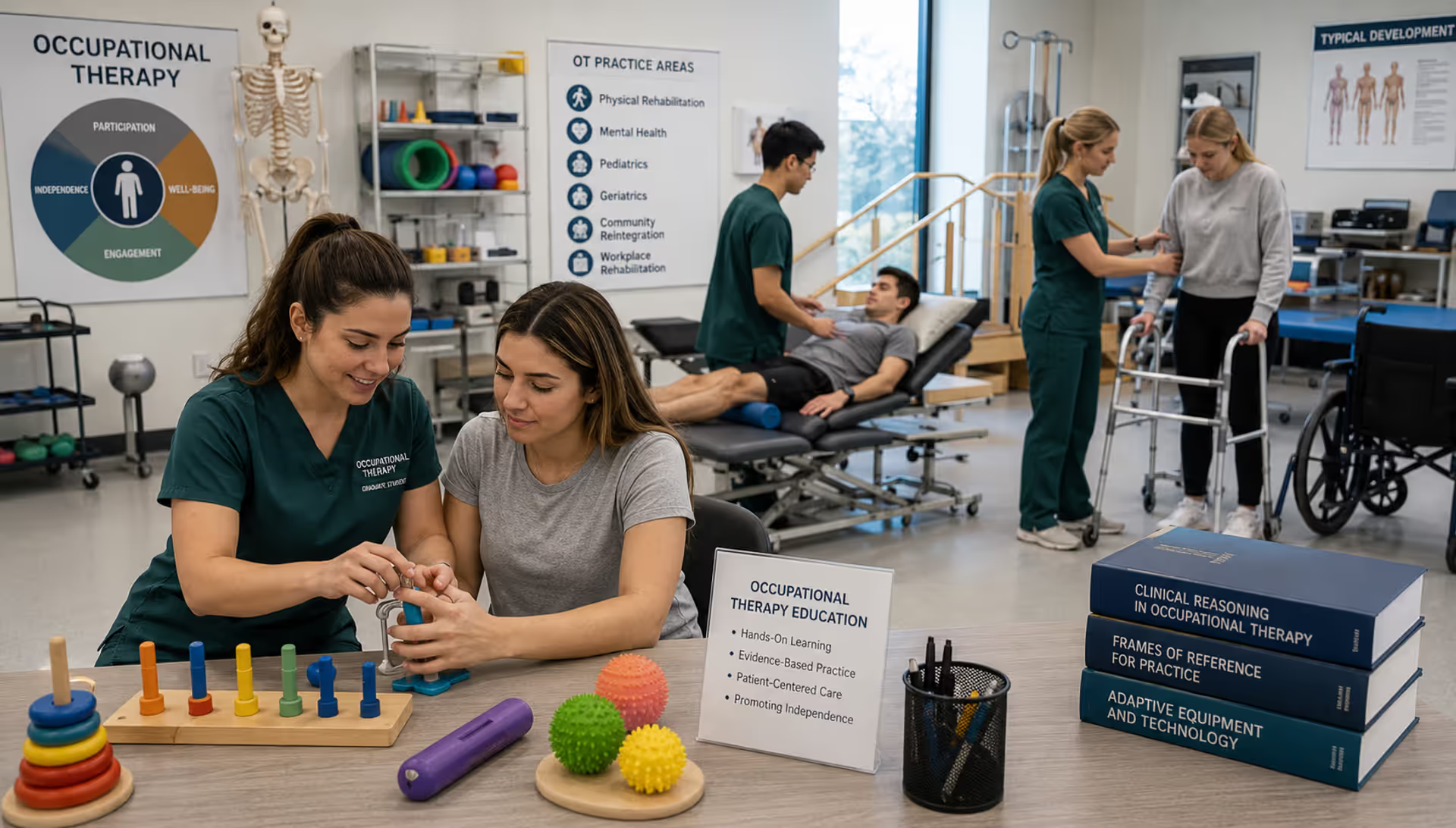
Students enrolled in Associate of Applied Science degree programs participating in hands-on career training
What Is an AAS Degree?

Choosing the right educational path can feel overwhelming when you're juggling career goals, time constraints, and budget. An Associate of Applied Science degree offers a practical, career-focused alternative to traditional four-year programs—but it's not the same as other associate degrees. Understanding what an AAS degree is, how it works, and whether it aligns with your professional ambitions will help you make a confident decision about your future.
AAS Degree Meaning and Core Characteristics
An AAS degree stands for Associate of Applied Science. It's a two-year undergraduate credential designed to prepare students for immediate entry into the workforce. Unlike more academically oriented associate degrees, the AAS emphasizes hands-on skills and technical training in specific career fields.
Most AAS programs require 60 to 70 credit hours. You'll typically complete them in two years of full-time study, though part-time options stretch that timeline. The curriculum focuses heavily on practical coursework—think lab work, clinical rotations, studio projects, or simulations—rather than broad liberal arts education.
Here's what sets the structure apart: roughly 60-70% of your credits go toward major-specific courses. The remaining 30-40% cover general education requirements like English composition, basic math, and perhaps a social science elective. That's a stark contrast to Associate of Arts (AA) or Associate of Science (AS) degrees, which dedicate nearly half their credits to general education.
The applied science designation tells employers you've trained for a specific job function. You're not just learning theory—you're practicing the skills the industry needs. That makes the AAS particularly popular in healthcare, business, technology, and skilled trades.
One pattern I see most often is students choosing an AAS when they want to start earning quickly. The degree gets you job-ready without the four-year commitment or the debt load that comes with a bachelor's degree.
How an AAS Degree Differs from AA and AS Degrees
The three associate degrees might sound similar, but they serve very different purposes. Your choice depends on whether you plan to transfer to a four-year university or jump straight into a career.
An AA (Associate of Arts) degree leans toward liberal arts and humanities. Think English, history, communications, or social sciences. It's built for students who plan to transfer and complete a bachelor's degree. Most of the credits transfer smoothly to four-year institutions.
An AS (Associate of Science) degree focuses on math, natural sciences, and technical subjects. Like the AA, it's designed as a transfer pathway—usually for students heading toward STEM bachelor's programs in fields like biology, engineering, or computer science.
The AAS, however, is a terminal degree. That means it's intended to be your final credential before entering the workforce. Transfer is possible, but it's not the primary goal. Many four-year colleges won't accept all your AAS credits, especially the highly specialized technical courses.
Here's a side-by-side comparison:
| Feature | AAS (Applied Science) | AA (Arts) | AS (Science) |
| Primary Focus | Career-specific technical skills | Liberal arts and humanities | Math and natural sciences |
| Transferability | Limited; many credits may not transfer | High; designed for transfer | High; designed for transfer |
| Curriculum Structure | 60-70% major courses, 30-40% general ed | 50% major courses, 50% general ed | 50% major courses, 50% general ed |
| Career Readiness | Immediate job entry | Requires bachelor's for most careers | Requires bachelor's for most careers |
| Example Programs | Nursing, HVAC, graphic design, accounting | Psychology, communications, education | Biology, chemistry, pre-engineering |
The simpler option usually wins here: if you want a job now, choose AAS. If you're planning to transfer and earn a bachelor's, go with AA or AS.

Author: Caleb Thornto;
Source: whitmuircommunityfarm.org
Popular AAS Degree Programs by Industry
AAS programs span dozens of career fields. Let's break down the most popular tracks and what they prepare you to do.
Healthcare AAS Programs
Healthcare dominates the AAS landscape. These programs train you for high-demand clinical and technical roles that don't require a bachelor's degree.
An associate in health science serves as a broad foundation. You'll study anatomy, medical terminology, healthcare ethics, and patient care basics. Graduates often work as medical assistants, health information technicians, or patient care coordinators. Some use it as a stepping stone toward more specialized credentials.
An associate degree in sonography (diagnostic medical sonography) is more specialized. You'll learn to operate ultrasound equipment, interpret images, and work directly with patients. Clinical rotations make up a significant chunk of the program. Sonographers earned a median salary of around $82,000 in 2026, and job growth remains strong as imaging technology advances.
Other healthcare AAS tracks include:
- Radiologic technology
- Respiratory therapy
- Dental hygiene
- Surgical technology
- Physical therapist assistant
These programs typically include state licensure or certification exams as part of the credential. That's a big advantage—you graduate ready to sit for your boards.
Business and Finance AAS Programs
A business associate degree with an applied science designation focuses on operational skills rather than broad business theory. You'll take courses in office management, business software, project coordination, and customer relations. Graduates often step into roles like administrative manager, operations coordinator, or small business owner.
An accounting associate degree (AAS in accounting) digs into bookkeeping, payroll, tax preparation, and financial software. You'll learn QuickBooks, Excel, and other industry-standard tools. Many programs prepare you for bookkeeper or accounting technician positions, with starting salaries around $45,000 to $55,000 depending on location and experience.
The AAS degree accounting track differs from a transfer-oriented AS in accounting. The AAS prioritizes practical application—you'll do more hands-on work with real financial statements and less abstract economic theory. That makes you job-ready faster, but it also means fewer credits will transfer if you later decide to pursue a bachelor's in accounting or finance.
Other business AAS options include:
- Human resources
- Marketing and digital media
- Supply chain management
- Hospitality management
These programs often include internships or capstone projects with local employers, giving you real-world experience before graduation.

Author: Caleb Thornto;
Source: whitmuircommunityfarm.org
Creative and Technical AAS Programs
An associate degree in graphic design blends artistic skill with technical software proficiency. You'll build a portfolio through projects in branding, web design, illustration, and print media. Programs emphasize Adobe Creative Suite, UI/UX principles, and client communication. Graduates work as junior designers, production artists, or freelancers, with entry-level salaries typically ranging from $38,000 to $50,000.
Technical AAS programs cover fields like:
- Information technology and cybersecurity
- Computer-aided design (CAD)
- Electronics and automation
- Manufacturing technology
- Automotive technology
These degrees thrive in industries where hands-on expertise matters more than theoretical knowledge. You'll spend significant time in labs, workshops, or simulation environments. Employers value the practical training—many hire directly from community college programs.
Social Sciences and Public Safety
An associates in criminal justice prepares you for entry-level law enforcement, corrections, or security roles. You'll study criminal law, investigative procedures, ethics, and report writing. Many students use this as a foundation for police academy training or positions in probation, court administration, or private security.
An associate degree in psychology is tricky. Most psychology AAS programs are rare because psychology careers typically require at least a bachelor's degree. When AAS psychology programs do exist, they focus on applied behavioral health roles—think mental health technician, case management assistant, or substance abuse support worker. If your goal is to become a licensed counselor or psychologist, you'll need to continue to a bachelor's and beyond. The AA or AS in psychology is usually the better transfer pathway.
Other public service AAS tracks include:
- Fire science
- Emergency medical services (paramedic)
- Homeland security
These programs often partner with local agencies for training and recruitment.
The AAS degree has become the backbone of workforce development in middle-skill occupations. Our graduates enter careers that offer stability, growth, and competitive wages without the burden of four-year tuition. Employers tell us repeatedly that they value the hands-on training and work-readiness these students bring from day one.
— Martinez Elena
Career Outcomes and Job Prospects with an AAS Degree
So what can you actually do with an AAS degree? The answer depends on your field, but the overall outlook is positive for many programs.
Median earnings for AAS graduates vary widely by industry. Healthcare and technical fields tend to pay more. Dental hygienists, for example, earn around $87,000 annually. Radiologic technologists average $68,000. On the business side, accounting technicians and administrative specialists typically start in the $42,000 to $55,000 range.
Employment rates for AAS graduates are generally strong. Community colleges report that 70-85% of AAS graduates find employment in their field within six months of graduation. That's higher than the rate for many bachelor's degree holders, partly because AAS programs target occupations with active hiring demand.
Industries that actively recruit AAS graduates include:
- Healthcare systems and private practices
- Manufacturing and logistics companies
- Technology firms (especially for IT support and cybersecurity)
- Government agencies (public safety, administration)
- Small businesses and startups (accounting, office management)
One common mistake? Assuming an AAS limits your career growth. That's not always true. Many fields offer clear advancement paths. A medical assistant can become a lead MA or office manager. An accounting technician can pursue additional certifications (like Certified Bookkeeper) and move into senior accounting roles. Some employers will even sponsor further education.
But it's fair to say that certain career ceilings exist without additional credentials. You won't become a CPA with just an AAS in accounting—you'll need a bachelor's and pass the CPA exam. You won't lead a psychology practice with an AAS. Understanding those limits upfront helps you plan.
How to Choose the Right AAS Program for Your Goals
Not all AAS programs are created equal. Here's what to evaluate before you enroll.
Accreditation matters. Make sure the college holds regional accreditation—that's the gold standard. For specialized programs (nursing, sonography, dental hygiene), look for programmatic accreditation from the relevant professional body. Employers and licensing boards care about this.
Program length and flexibility vary. Most AAS degrees take two years full-time, but some accelerated programs finish in 18 months. Others offer evening, weekend, or online formats for working adults. If you're balancing a job or family, flexibility can make or break your success.
Cost is a big factor. Community colleges are far cheaper than four-year schools—expect $3,500 to $8,000 per year in tuition for in-state students. Financial aid, Pell Grants, and workforce development scholarships can reduce that further. Calculate your total cost, including books, fees, and any required equipment or uniforms.
Hands-on training opportunities separate strong programs from weak ones. Ask about:
- Clinical rotations or internships
- Lab facilities and equipment quality
- Industry partnerships and guest instructors
- Capstone or portfolio projects
The more real-world practice you get, the more confident you'll feel on the job.
Job placement rates tell you how well the program connects graduates to employers. Ask the admissions office for data. A program with 80%+ placement in-field within six months is a good sign. Also ask about employer partnerships—some colleges have direct pipelines to local companies.
Online vs. on-campus depends on your field. Technical and healthcare programs require in-person labs and clinicals. Business, IT, and some criminal justice programs adapt well to online formats. Hybrid models—online theory with occasional on-campus labs—offer a middle ground.
One counterintuitive point: don't choose a program solely based on salary data. Job satisfaction, work-life balance, and personal interest matter just as much. The highest-paying AAS field won't feel worth it if you hate the work.

Author: Caleb Thornto;
Source: whitmuircommunityfarm.org
FAQ: AAS Degree Questions Answered
Choosing an AAS degree means prioritizing practical skills, immediate employability, and a faster path to earning. It's not the right fit for everyone—especially if you're set on a career that requires a bachelor's degree or if you want the full four-year college experience. But for students who want to start working sooner, minimize debt, and train for a specific job, the AAS delivers real value. Research your options, talk to program advisors, and make sure the degree aligns with both your short-term needs and your long-term career vision.
Related Stories

Read more

Read more



The content on this website is provided for general informational and educational purposes only. It is intended to explain concepts related to professional training, certifications, vocational education, online courses, and continuing education.
All information on this website, including articles, guides, and examples, is presented for general educational purposes. Outcomes may vary depending on individual choices, program selection, and personal effort.
This website does not provide professional career counseling or guarantee educational outcomes, and the information presented should not be used as a substitute for consultation with qualified educators, trainers, or career advisors.
The website and its authors are not responsible for any errors or omissions, or for any outcomes resulting from decisions made based on the information provided on this website.