
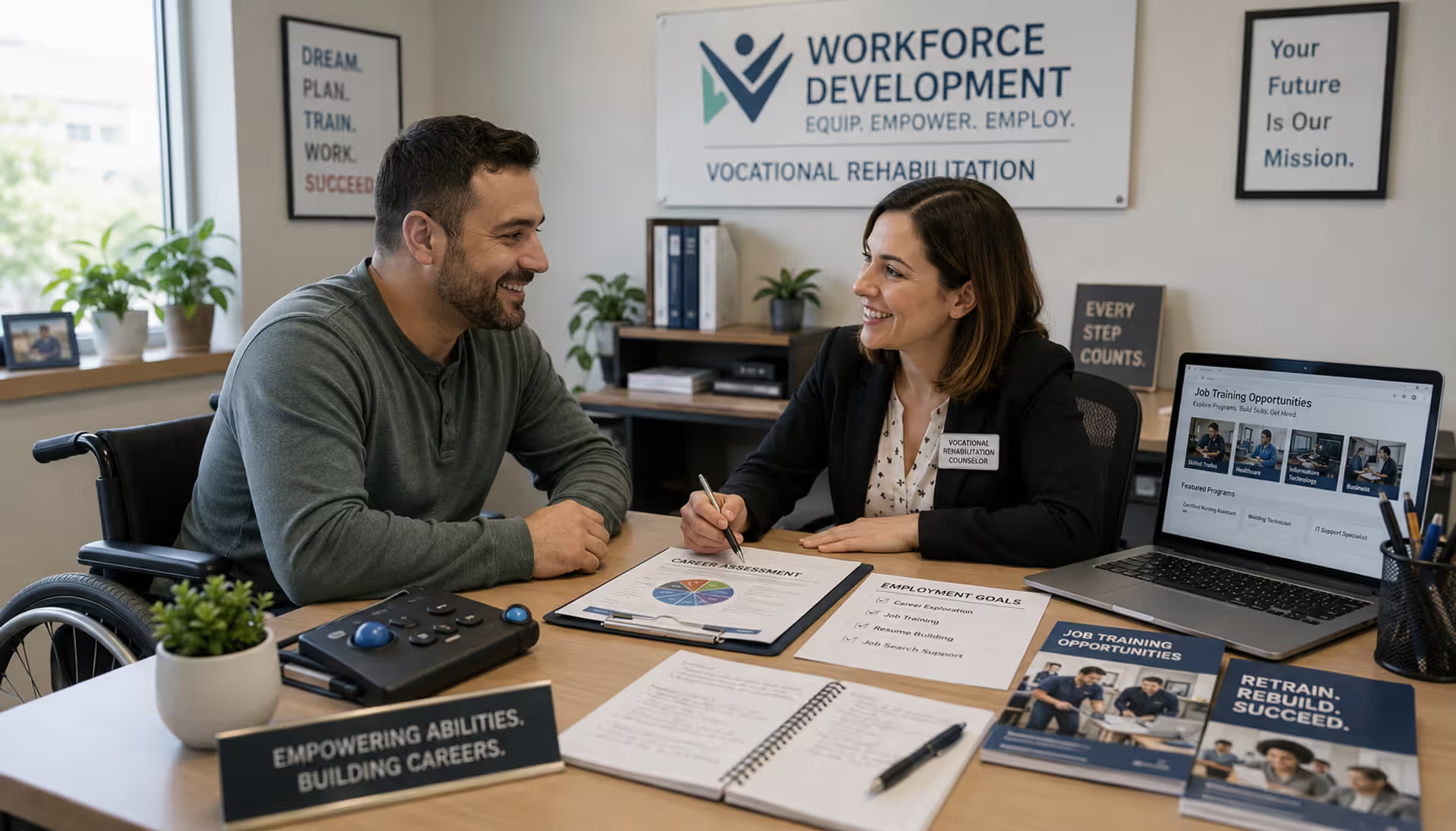
Vocational rehabilitation counselor helping an adult client explore job training and career opportunities
Vocational Rehabilitation Services Guide

Getting back to work after an injury, dealing with a disability, or hitting employment roadblocks can feel like you're stuck. Here's what most people don't realize: there's an entire network of programs—many completely free—built specifically to help you retrain, rebuild your skills, and land a job that actually works for your situation. State agencies, the VA, even major employers all fund different versions of these services. If you've been out of work or struggling to find something that fits your physical or mental capabilities, vocational rehabilitation might be the reset button you didn't know existed.
What Are Vocational Rehabilitation Services?
Think of vocational rehabilitation as a bridge. On one side, you've got employment barriers—maybe a disability, an injury that changed what you can do physically, or a condition that makes standard job hunting nearly impossible. On the other side, there's a paycheck and a career that fits your actual abilities. VR programs build that bridge through testing, training, and ongoing support.
Every state runs its own VR agency, usually tucked inside the workforce development or human services department. These offices work with anyone whose disability—physical, mental, cognitive, or emotional—blocks them from getting or keeping work. You're not required to be on Social Security disability. You're not required to be completely unable to work. The bar is lower than most people think: you just need documented proof that your condition makes employment significantly harder.
Veterans get their own separate track through the Department of Veterans Affairs. The program's official name is Veteran Readiness and Employment, but everyone still calls it Chapter 31. Unlike basic job training, this program can bankroll a four-year degree, fund an apprenticeship, or even help you launch your own business if that's the best path for your disability.
Private organizations fill in gaps the government programs miss. Goodwill, Easter Seals, and local workforce boards run their own VR services. Some specialize: brain injury survivors, people in recovery from addiction, adults on the autism spectrum. The approach varies, but the goal stays consistent—match your capabilities to real jobs that exist in your local market.
Here's what you typically get: career counseling that goes beyond generic advice, skills testing to figure out what you're actually good at, funding for training or education, assistive technology if you need it, help with the job search itself, and support for workplace accommodations. Some programs even cover medical treatment if it's the only thing standing between you and employment.
State VR eligibility hinges on documentation. Medical records, psychological evaluations, educational assessments—something official that proves your disability interferes with work. Veterans need a service-connected disability rating from the VA: at least 10% with an employment handicap, or 20% with a serious employment handicap. That "employment handicap" determination happens during your initial VA evaluation, not automatically based on your rating number.

Author: Caleb Thornto;
Source: whitmuircommunityfarm.org
Types of Vocational Rehabilitation Programs Available
You've got options here. Four major program types exist, each with different money sources and different rules about who gets in.
State-Funded Vocational Rehabilitation
State VR is the workhorse of the entire system. Federal money flows through the Rehabilitation Act, but states run the show. That means California's program looks different from Florida's, and Texas handles things differently than New York.
Qualifying conditions run the full spectrum: mobility problems, vision or hearing loss, mental health diagnoses like depression or bipolar disorder, intellectual disabilities, chronic illnesses that limit what you can do for eight hours straight. The common thread is employment impact. Your condition has to create what the law calls a "substantial barrier"—bureaucratic language for "this makes getting hired or staying employed genuinely difficult."
After you apply, you'll sit down with a counselor for intake. They'll dig into your work history, education background, medical situation, and what kind of work you're aiming for. Bring any medical records or evaluations you have. If your documentation is old or missing, the agency can arrange new assessments.
Eligible applicants get assigned a counselor who helps create an Individualized Plan for Employment—everyone calls it an IPE. This written plan spells out your career target and exactly what services the agency will provide to get you there. It's a contract, basically, signed by both sides.
Services can include community college tuition, trade school costs, certification exam fees, work clothes and tools, gas money during training, and job coaching once you're hired. Most people underestimate the scope. I've seen state VR pay for welding gear, nursing school prerequisites, commercial driver's license training, and a $3,000 laptop for a graphic design program.
The catch: when budgets get tight, states implement "order of selection." People with the most severe disabilities get priority. Less severe cases might sit on a waiting list for months. It's frustrating but legal under federal regulations.
Chapter 31 Benefits for Veterans
Chapter 31 is probably the most underused VA benefit out there. Veterans either don't know it exists or assume it's only for people who can't work at all. Wrong on both counts.
You need a service-connected disability rating and what the VA defines as an employment handicap. That means your service-connected condition limits your ability to prepare for work, get hired, or stay employed in a suitable job. The VA decides this during your evaluation—it's not automatic even if you have a 50% rating.
The program provides up to 48 months of benefits. That's enough for a bachelor's degree, an associate degree, a certificate program, an apprenticeship, on-the-job training, or entrepreneurship support if you want to work for yourself. Veterans in degree programs receive monthly housing allowances similar to Post-9/11 GI Bill rates, adjusted for your location.
What separates Chapter 31 from the GI Bill: it's an entitlement, not a time-limited benefit you earned through service. Need accommodations? Assistive technology? Extra tutoring because of your disability? VR&E covers it. The program also pays for supplies, equipment, and licensing fees related to your training goal.
IT training is huge under Chapter 31. Technology careers pay well, often allow remote work, and accommodate many service-connected disabilities better than physical jobs. Coding bootcamps, cybersecurity certificates, network administration courses—all commonly approved. I've seen veterans with PTSD thrive in programming careers specifically because the work environment can be controlled and predictable.
You start by submitting VA Form 28-1900. After that, you'll meet with a Vocational Rehabilitation Counselor for evaluation. This person becomes your advocate and guide through the entire program. They'll help you pick a realistic career path and make sure you get the support you need.
Employer Tuition Assistance Programs
Large employers increasingly offer tuition assistance as a recruitment and retention tool. These aren't traditional vocational rehabilitation, but they serve a similar function: helping workers gain skills and move up.
Typical programs cover a percentage of tuition for approved courses or degrees. Some companies pay 100% upfront; others reimburse after you pass your classes. Annual caps range from $2,500 at smaller companies to $25,000 at major corporations.
Common requirements: you've worked there at least six months to a year, you're maintaining full-time or sometimes part-time status, and you're pursuing education relevant to your current role or potential advancement within the company. Some employers require you to stay for a set period after finishing your education or you'll have to repay the assistance.
Amazon's Career Choice program prepays tuition for high-demand fields even if they have nothing to do with your warehouse job. Walmart covers costs for degrees in business or supply chain management. Starbucks partners with Arizona State University for online degrees. UPS has funded education for part-time package handlers for decades. Most large healthcare systems offer generous tuition benefits because they're constantly trying to move CNAs into nursing programs and nurses into advanced practice roles.
The advantage is obvious: you're collecting a paycheck while you learn. The downside is juggling work, classes, and life. Success requires either a very understanding manager who'll work around your class schedule or the stamina to work full-time and attend school at night.

Author: Caleb Thornto;
Source: whitmuircommunityfarm.org
How Vocational Assessment Works
You can't build a career plan without knowing what you're working with. That's where vocational assessment comes in—a comprehensive evaluation that takes several sessions over a few weeks.
This isn't a single test you pass or fail. It's a multi-part evaluation examining your abilities, interests, physical capabilities, and work style.
Aptitude tests measure natural strengths in areas like mechanical reasoning, spatial relations, clerical speed and accuracy, math ability, and verbal comprehension. These reveal fields where you'd likely succeed without years of training. Someone who scores high on spatial relations might excel in drafting or dental hygiene. Strong mechanical reasoning suggests trades like HVAC or automotive repair.
Interest inventories explore what types of work would actually satisfy you. The Strong Interest Inventory is most common—it compares your preferences to people successfully working in hundreds of occupations. You might discover careers you never considered. I've seen people surprised to learn their interests align with respiratory therapy or court reporting.
Physical capacity evaluations define what you can do, not what you can't. Can you stand for a full shift? Lift 40 pounds occasionally? Work in loud environments? Type for extended periods? Tolerate cold or heat? These answers guide job matching and accommodation planning.
Work samples put you in simulated work situations. You might assemble small components, sort items by category, use Microsoft Office, or handle mock customer service calls. Counselors observe your work pace, accuracy, problem-solving approach, and stamina. This reveals how you actually perform under work conditions, not just how you test.
Transferable skills analysis reviews your past work to identify skills that apply to new fields. Retail experience means customer service skills. Military service means following procedures and working under pressure. Parenting means organizational skills and multitasking ability. This analysis is critical for people who need to switch careers entirely due to disability.
The results produce a detailed report recommending suitable occupations, identifying training needs, and suggesting accommodations. Your counselor uses this to build your training plan.
One mistake people make: treating assessment like a test to ace. You can't game it. If you exaggerate your abilities, you'll end up in training or a job that doesn't fit, wasting months or years. The goal is accuracy, not impressing anyone.
Paid Training Programs and Apprenticeships
Here's the problem with most career training: you're expected to pay tuition and sacrifice income while you learn. Paid training flips that model entirely.
Programs for adults who need income while retraining come in several forms. Some are classroom-based with stipends. Others are on-the-job training where you earn wages from day one while learning under supervision. The best programs lead directly to employment, often with the company providing the training.
Apprenticeships represent the gold standard. You're combining classroom instruction with hands-on work experience. You earn wages that increase as your skills develop—typically starting around 40-50% of what experienced workers make and reaching full wages upon completion.
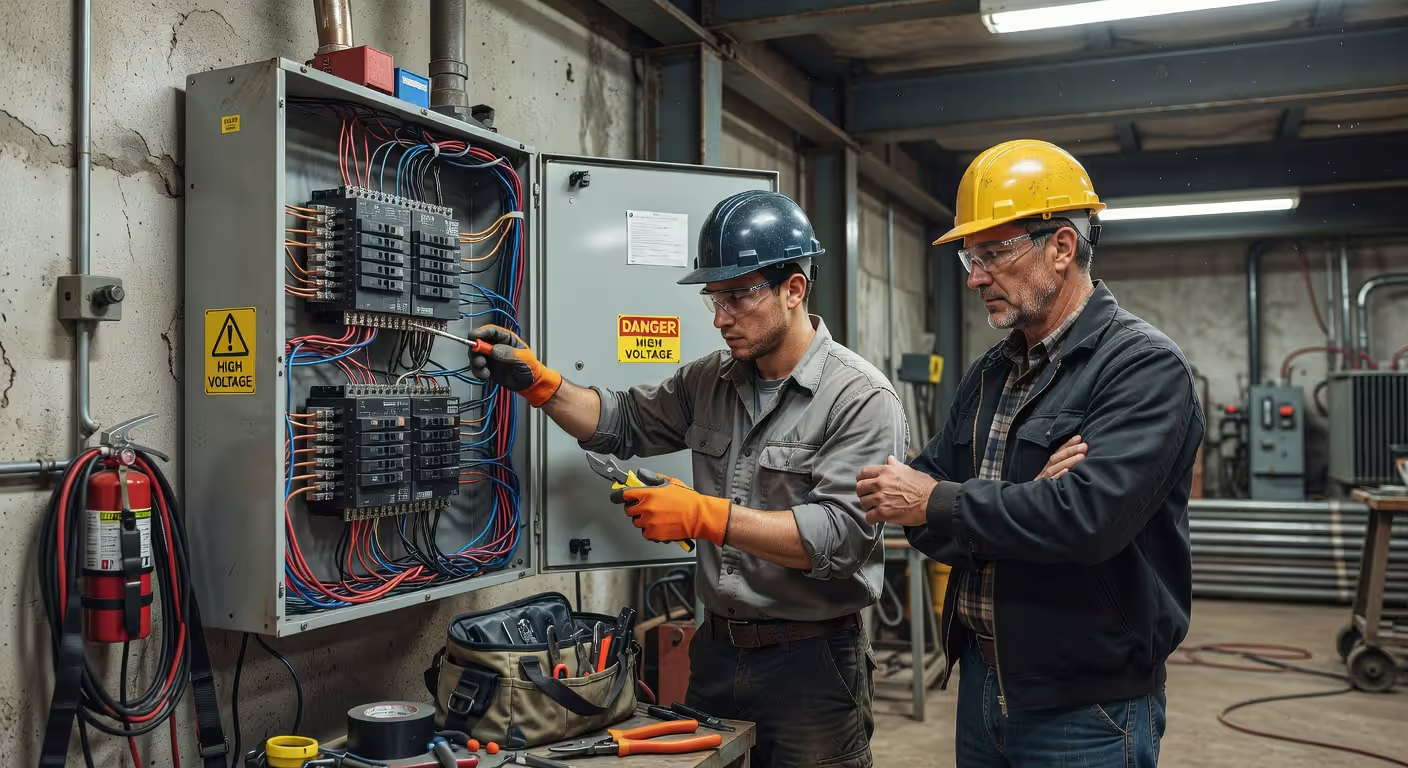
Electrical apprenticeships are among the oldest and most structured. Programs typically run four to five years and include roughly 8,000 hours of on-the-job training plus 576 hours in the classroom. You'll learn residential wiring, commercial electrical systems, industrial controls, blueprint reading, National Electrical Code, and safety procedures.
Starting wages for electrical apprentices vary by location and union status but generally fall between $18 and $25 hourly. Journeyman electricians in most markets earn between $60,000 and $90,000 yearly—more in high-cost areas, less in rural regions. The work is steady because electrical systems need constant installation, maintenance, and updating.
Other solid apprenticeship trades: plumbing, HVAC, carpentry, welding, industrial maintenance. Healthcare apprenticeships are expanding rapidly for medical assistants, pharmacy technicians, and dental assistants. Some tech companies now offer software development apprenticeships, though these are less common than traditional trades.
"Free" trades training exists but usually isn't actually free in the sense of open to everyone. Most programs advertised as free are funded through vocational rehabilitation, workforce development grants, or union sponsorship—you need to qualify for the underlying funding source. Community colleges sometimes offer free or reduced-cost trade certificates for low-income students through Workforce Innovation and Opportunity Act grants, but eligibility requirements apply.
Finding apprenticeships: start with the Department of Labor's Apprenticeship Finder at apprenticeship.gov. This database lists registered programs by location and occupation. You can also contact union halls directly—IBEW for electricians, UA for plumbers, sheet metal workers' unions for HVAC. Many unions run their own apprenticeship programs with strong job placement rates.
Applications typically require a high school diploma or GED, minimum age 18, and passing a basic aptitude test covering reading comprehension and math. Some trades have additional requirements: electricians need normal color vision to identify wire colors, line workers need comfort with heights, some construction trades require lifting 50+ pounds regularly.
Competition for popular programs can be fierce. Prepare for your interview like you would for a job. Highlight any relevant experience, even if it's just helping a family member with home repairs. Show up on time, dress appropriately, and demonstrate genuine interest in the trade.
Author: Caleb Thornto;
Source: whitmuircommunityfarm.org
Comparison of Major Vocational Rehabilitation Programs
| Program Type | Who Can Apply | Money Source | What's Covered | How Long | Do You Get Paid? | How to Apply |
| State VR Programs | Documented disability that creates work barriers; U.S. citizenship or eligible immigration status | Federal and state funding | Job training, college, trade schools, certifications, assistive technology | Varies widely; typically 2-4 years | No direct payment, though some states offer stipends | Contact your state VR agency; complete intake interview; create IPE with your counselor |
| Chapter 31 VA Benefits | Service-connected disability rating (minimum 10% with employment handicap or 20% with serious employment handicap); must be a veteran | Department of Veterans Affairs | College degrees, trade programs, apprenticeships, on-the-job training, self-employment support | Maximum 48 months of benefits | No wages, but monthly housing allowance provided | File VA Form 28-1900; attend evaluation appointment; partner with your VRC |
| Employer Tuition Assistance | Current employee at participating company; typically must meet minimum tenure requirement | Company funds | College courses, degree programs connected to career advancement within company | Ongoing benefit during employment | No extra pay, but you keep earning your regular salary while studying part-time | Submit request through company HR; obtain approval before enrolling in courses |
| Trade Apprenticeships | Minimum age 18; high school diploma or GED; pass aptitude assessment; meet physical demands of trade | Employer wages supplemented by federal/state support | Hands-on trade training combined with classroom education | 1-5 years based on specific trade | Yes, wages increase as skill level advances | Search apprenticeship.gov or contact union halls; complete interview; take aptitude test |
Who Qualifies for Vocational Rehabilitation Services
Eligibility rules differ dramatically depending on which program you're pursuing. You might qualify for one but not another.
State vocational rehabilitation requires three elements: a documented physical or mental impairment, proof that this impairment creates a substantial employment barrier, and reasonable expectation that VR services will enable you to obtain or maintain employment. Medical records, psychological evaluations, or educational assessments must verify the disability.
"Substantial barrier" gets interpreted more broadly than you'd expect. You don't have to be completely unable to work—the standard is whether your disability makes finding or keeping appropriate employment significantly more difficult than it would be otherwise. Qualifying conditions commonly include mobility impairments, chronic pain, vision or hearing loss, mental health disorders like major depression or anxiety, learning disabilities, autism spectrum disorders, traumatic brain injury, and chronic illnesses like diabetes or heart disease when they meaningfully limit work capacity.
Social Security disability benefits aren't required for state VR eligibility. Many VR clients work part-time or are unemployed but not disabled enough for SSDI or SSI. State VR targets people who can work with appropriate support and training, not people who can't work at all.
Chapter 31 has more rigid requirements. You must be a veteran holding a service-connected disability rating from the VA. Your rating must reach at least 10% and you must have an employment handicap, or reach at least 20% with a serious employment handicap. Active duty service members awaiting discharge for medical conditions can also qualify.
The employment handicap determination happens during your initial VA evaluation—it's not automatic based on rating percentage alone. A 30% PTSD rating might constitute an employment handicap if symptoms affect your ability to work with others or handle workplace stress, while a 30% rating for a knee injury might not if you're pursuing sedentary work. The VA makes individualized determinations.
Employer tuition assistance programs create their own eligibility rules. Common requirements include regular full-time or part-time employee status (contractors usually excluded), completion of minimum service period (often 90 days to one year), maintaining satisfactory job performance, and pursuing education connected to current or potential roles within the organization. Policies vary—some employers extend benefits to part-time workers while others restrict them to full-time staff.
Trade apprenticeships require meeting the specific trade's physical and educational standards. Most demand high school diploma or GED equivalent, minimum age 18, and passing basic aptitude tests in reading and math. Additional requirements vary by trade: electricians need normal color vision to identify wire insulation colors, telecommunications tower workers need comfort at heights, many construction trades require ability to lift 50+ pounds regularly.
Income limits generally don't apply to vocational rehabilitation programs. State VR and Chapter 31 serve people regardless of household income. Your spouse could earn $150,000 annually and you'd still qualify if you meet disability and employment barrier criteria. This surprises people who assume these programs target only low-income populations.
What makes vocational rehabilitation truly work isn't the money or even the training itself—it's having someone in your corner who actually believes you can succeed. When clients have a counselor who helps them navigate obstacles and sees their potential beyond their disability or employment gap, success rates jump dramatically. We're not just transferring skills; we're rebuilding people's confidence and proving they bring real value to employers.
— Martinez Rebecca
How to Apply for Vocational Rehabilitation
The application process follows predictable steps once you know where to start. Here's the roadmap.
State vocational rehabilitation applications begin with locating your state's VR agency. Search "[your state] vocational rehabilitation" or visit the Council of State Administrators of Vocational Rehabilitation website for direct links to all state agencies. Application methods vary—most states accept online applications, phone applications, or walk-in applications.
Initial applications are usually straightforward forms requesting contact information, current employment status, disability details, and work goals. Extensive documentation isn't required at this stage—just enough information to explain why you're seeking services.
After submitting your application, expect to be scheduled for an intake interview within several weeks. Bring medical records, psychological evaluations, or educational assessments documenting your disability. If you lack recent documentation, the VR agency can arrange evaluations.
During intake, counselors ask about work history, education, disability details, how your disability affects employment, and career interests. Be straightforward about limitations but also about strengths. The objective is finding a realistic career path, not proving maximum disability.
Eligible applicants receive assignment to a counselor who collaborates with them to develop an Individualized Plan for Employment. This written plan specifies career goal, services VR will provide, client responsibilities, and expected timeline. Both parties sign the IPE—it represents mutual commitment.
Services typically begin within a month after finalizing your IPE. Completion timeline varies based on career goal. Short-term certificate programs might take six months; bachelor's degrees require four years.
Chapter 31 applications start with submitting VA Form 28-1900 through the VA website, by mail, or at a VA regional office. eBenefits account holders can apply online through that portal. You'll need service information and disability rating documentation.
The VA schedules initial evaluation with a Vocational Rehabilitation Counselor at a VA facility or through telehealth. This evaluation assesses employment handicap and determines entitlement to services. Approved applicants work with their VRC to develop rehabilitation plans.
VA evaluations can take several weeks to several months depending on appointment availability and case complexity. Once approved with a plan in place, benefits begin when training starts.
Employer tuition assistance applications process through company HR departments or benefits portals. Approval is typically required before enrolling in courses. Submit requests including course or program details, relevance to your job or career path within the company, cost breakdown, and schedule. Approval timeframes range from several days to several weeks depending on company procedures.
Trade apprenticeship applications go directly to program sponsors. For union apprenticeships, contact the local union hall for your target trade. For non-union programs, apply through the employer or apprenticeship.gov. Most programs accept applications during specific windows—often once or twice yearly.
Applications usually include basic forms, high school transcript or GED certificate, and sometimes recommendation letters. Passing initial screening leads to aptitude testing invitations. Test passers receive interview invitations. Programs select candidates based on test scores, interview performance, and sometimes additional factors like veteran preference or local residency.
One common mistake: waiting until everything's perfect before applying. You don't need a polished resume or crystal-clear career plan to begin. Counselors expect to provide guidance—that's their entire job. Apply when you recognize you need help, and let the process guide you toward specifics.

Author: Caleb Thornto;
Source: whitmuircommunityfarm.org
FAQ: Vocational Rehabilitation Services Questions Answered
Vocational rehabilitation services create a viable path forward for people facing employment barriers due to disability, injury, or challenging life circumstances. Whether you're working with a state agency, using veteran benefits, or accessing employer-sponsored programs, support exists to help you build a sustainable career. The application process might seem overwhelming initially, but counselors expect to guide you through it—that's precisely what they're there for. Start by reaching out to the program matching your situation, be honest about your abilities and limitations, and stay engaged with the process. The time investment pays off in long-term employment and financial stability.
Related Stories

Read more

Read more



The content on this website is provided for general informational and educational purposes only. It is intended to explain concepts related to professional training, certifications, vocational education, online courses, and continuing education.
All information on this website, including articles, guides, and examples, is presented for general educational purposes. Outcomes may vary depending on individual choices, program selection, and personal effort.
This website does not provide professional career counseling or guarantee educational outcomes, and the information presented should not be used as a substitute for consultation with qualified educators, trainers, or career advisors.
The website and its authors are not responsible for any errors or omissions, or for any outcomes resulting from decisions made based on the information provided on this website.