

Dental Hygienist Conducting a Preventive Dental Cleaning and Oral Health Assessment in a Modern Clinic
How to Choose Medical Assistant Programs?

You're staring at a list of medical assistant schools, and they all sound the same. Fast training. Great jobs. Affordable tuition. But which one actually delivers?
Here's what nobody tells you upfront: the school you pick determines whether you can even take certification exams, whether local hospitals will interview you, and how confident you'll feel when a patient needs their blood drawn on your first day. Some programs set you up for success. Others leave you with debt and credentials that employers don't recognize.
Medical assisting jobs are projected to jump 14% through 2031—that's nearly 123,000 new positions, according to BLS data. Healthcare facilities need trained assistants, but they're also raising their standards. More employers now require certification, which means your training needs to meet specific benchmarks before you even apply.
This breakdown covers the practical stuff: which accreditation bodies actually matter, how different program formats work in real life, what you'll actually spend (not just tuition), and how to spot programs that cut corners. If you're weighing a nine-month certificate against a two-year degree, or wondering if online training holds up against campus programs, you'll get those answers here.
What Is a Medical Assistant Program?
Medical assistant training prepares you for dual-role work in healthcare facilities—you'll handle both patient care tasks and office operations. In a typical day, you might check vital signs, prep exam rooms, draw blood, administer injections, update patient charts in electronic systems, verify insurance, and coordinate referrals.
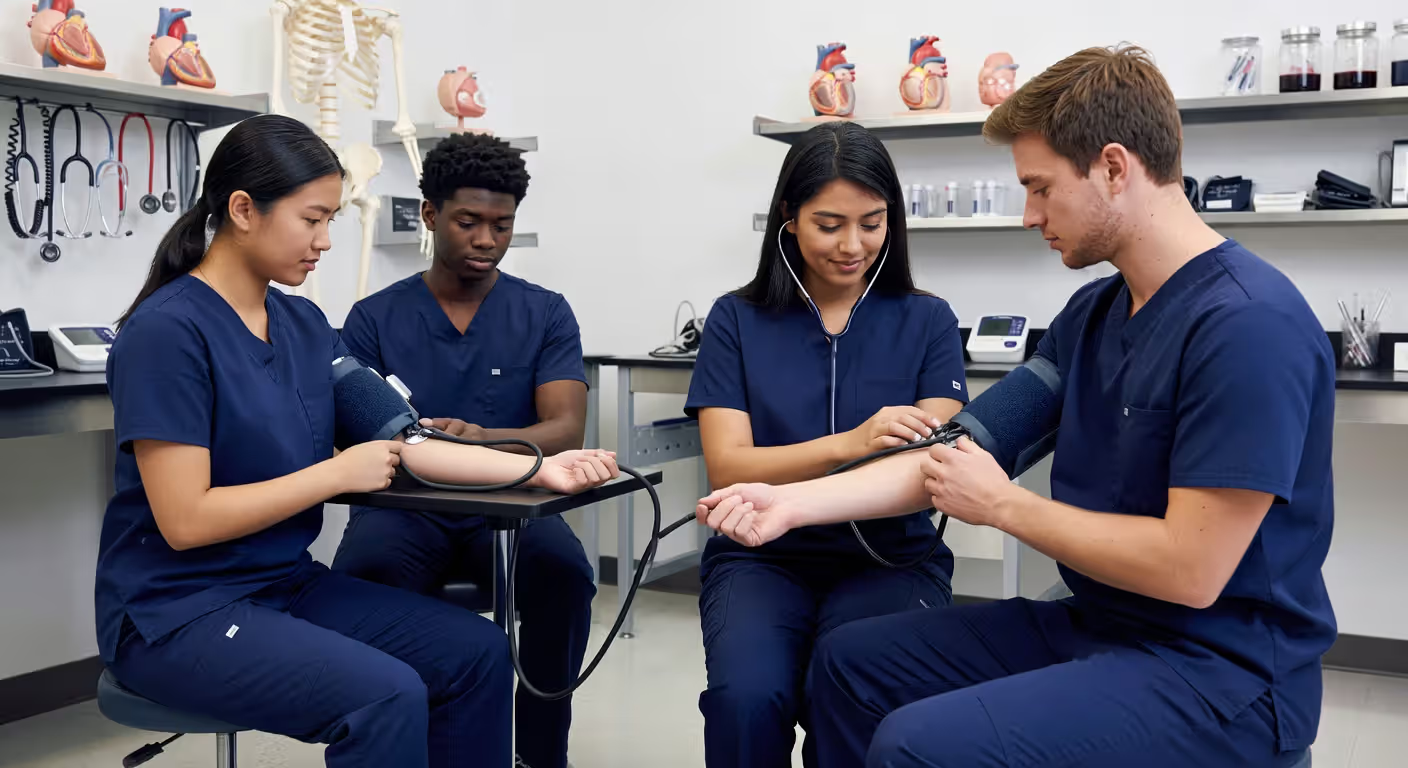
The training combines classroom theory with supervised practice. Core topics include anatomy, physiology, medical terminology, basic pharmacology, infection control protocols, patient interaction techniques, insurance billing, and medical coding. You'll practice venipuncture, EKG procedures, sterile technique, and minor surgical assisting before working with actual patients.
Where you end up after graduation: most medical assistants work in physician offices, outpatient clinics, urgent care centers, or specialty practices like dermatology or cardiology. Hospital employment happens too, though less commonly. The role sits between purely clinical positions (like nurses) and administrative staff (like medical records clerks)—you do both.
Training comes in three distinct formats, each with different time commitments and outcomes:
Certificate programs get you working fastest—usually nine to twelve months. These skip general education entirely and drill down on medical assisting competencies. You're learning anatomy one week, practicing injections the next, then rotating through billing software. Community colleges run most of these, along with technical schools. If your only goal is working as a medical assistant and you need income soon, certificates make sense.
Diploma programs last about a year, similar to certificates. The main difference? They're typically offered through private career colleges rather than community schools. Content-wise, they're nearly identical—focused medical assisting training without broader academics. The "diploma" label is more about institutional naming conventions than meaningful curriculum differences. What matters is accreditation status and clinical hour requirements, not whether it's called a certificate or diploma.
Associate degree programs require two full years. Half your time goes to general education—composition, math, psychology, communications, maybe a science elective. The other half covers medical assisting. These cost more and delay your earning timeline, but they offer flexibility later. If you eventually want to pursue nursing or health administration, those gen-ed credits transfer. Some employers also prefer degree holders for lead medical assistant or specialty positions, though that's not universal.

Author: Vanessa Holloway;
Source: whitmuircommunityfarm.org
Types of Medical Assistant Programs Available
Format affects everything: your daily schedule, how you learn procedures, and when you can start earning. Each structure has distinct advantages and limitations.
Campus-Based Programs
Traditional campus training puts you in classrooms and labs several days weekly. You're learning alongside classmates, practicing procedures on mannequins and each other before touching real patients during externships. Instructors demonstrate techniques in person, then watch you practice and correct your form immediately.
This structure works well if you prefer routine and direct feedback. Most programs schedule classes two to four days weekly, with lab time built into those days. The clinical externship—typically 160 to 240 supervised hours at a medical facility—happens during your final term.
The downside? Rigid scheduling. If you work full-time or have childcare responsibilities, fitting campus hours into your week gets complicated. Missing a lab session means scrambling to make it up, and not all programs offer flexibility. You're also limited geographically—you need to live within reasonable commuting distance of the campus.
Online and Hybrid Programs
Distance learning for medical assisting has expanded dramatically since 2020. Accreditation bodies now recognize quality online programs, but there's a catch you need to understand: clinical skills can't be taught through a screen. Every "online" program includes mandatory in-person components.
The typical structure works like this: lectures, readings, quizzes, and exams happen online on your schedule. Then you attend condensed on-campus lab sessions—maybe a weekend every month, or a week-long intensive each term—to practice clinical procedures. Your externship still happens locally at a partnered healthcare facility.
This format attracts working adults who can't commit to regular daytime campus schedules. You watch lectures at 10 PM after your kids sleep, complete assignments on weekends, then block off specific dates for hands-on training. Some programs partner with approved training sites near you, so you're not traveling to the main campus for every lab session.
Before enrolling, pin down exactly how many in-person days are required, where they happen, and how much advance notice you get for scheduling. "Fully online" marketing can mislead—I've seen programs advertised as online that require two full weeks on campus each semester.
One reality check: online doesn't mean easier. You're covering identical material, and you need serious self-discipline to keep pace without the structure of scheduled classes. Students who procrastinate struggle.
Accelerated Programs
Accelerated tracks compress standard curriculum into six to nine months for certificates. You're in class or clinical training most days, often full-time hours, with shortened breaks between terms. It's intensive immersion—covering in six months what typical programs spread across twelve.
This appeals to career changers who want to start working quickly and can afford not to work during training. If you learn well under pressure and prefer getting through material fast, acceleration works. You also save on living expenses by finishing sooner, even if per-credit costs run higher.
The trade-off is intensity bordering on overwhelming. You're absorbing massive amounts of information rapidly, and falling behind even one week creates a cascade effect. Life disruptions—sick kids, car trouble, family emergencies—become serious problems when you're on a compressed timeline.
Watch for this: some accelerated programs maintain full clinical hours (160+), while others cut corners to fit the timeframe. Verify that your program includes sufficient externship hours to meet certification exam requirements.
Accreditation and Certification Requirements
Accreditation status is the single factor that determines whether your training has value in the job market. Skip this part and you risk wasting thousands of dollars on credentials nobody recognizes.
Two bodies accredit medical assistant programs nationally: CAAHEP (Commission on Accreditation of Allied Health Education Programs) and ABHES (Accrediting Bureau of Health Education Schools). Both hold US Department of Education recognition. Programs undergo rigorous evaluation of curriculum quality, faculty credentials, clinical training adequacy, and graduate outcomes to earn accreditation.
The practical impact: major certification exams require graduation from CAAHEP or ABHES programs. The CMA (Certified Medical Assistant) exam through AAMA and the RMA (Registered Medical Assistant) exam through AMT both mandate accredited program completion. Without that, you can't even sit for the test.
Most employers now prefer or explicitly require certification. Certified medical assistants typically earn $3,000 to $5,000 more annually than non-certified counterparts. Large healthcare systems, hospital networks, and specialty practices often won't consider applications from uncertified candidates anymore.
Technically, you can work as a medical assistant without certification in most states—there's no legal requirement. But job prospects narrow significantly. Smaller private practices might hire you, but advancement opportunities and pay remain limited.
Accreditation isn't just a checkbox—it's your assurance that the program meets national standards for clinical competency and that your training will be recognized by employers and credentialing bodies. I've seen too many students graduate from unaccredited programs only to discover they can't take certification exams or that local employers won't consider their applications.
— Thompson Sarah
Here's the distinction that matters: "accredited programs" hold CAAHEP or ABHES status and prepare you for certification exams. "Non-accredited programs" don't meet those standards. Some are legitimate state-approved schools that serve regional markets; others are essentially scams selling worthless diplomas.
Before handing over money or signing enrollment documents, verify accreditation directly on CAAHEP's or ABHES's official website. Don't trust the school's marketing materials. If a program claims it's "seeking accreditation" or "in candidacy status," that's not the same as being accredited—you're gambling on their future approval.

Author: Vanessa Holloway;
Source: whitmuircommunityfarm.org
How Long Does a Medical Assistant Program Take?
Timeline varies based on credential type, enrollment status, and program structure. Here's what to realistically expect:
Certificate programs run nine to twelve months at full-time enrollment. Part-time pacing stretches this to fifteen or eighteen months. These focus purely on medical assisting competencies—no English composition or algebra requirements—making them the fastest route to employment.
Diploma programs typically last twelve months full-time, essentially matching certificate timelines. The credential name differs, but functionally they're equivalent in duration and focus.
Associate degree programs require two years (four semesters) full-time, or three to four years part-time. Roughly half your coursework covers general education—writing, social sciences, math, communications—with the other half devoted to medical assisting training. Clinical externships usually occur in the final semester.
Several variables affect your actual completion time:
Full-time versus part-time enrollment creates the biggest difference. Full-time typically means twelve to fifteen credit hours per semester, or twenty to thirty hours weekly in certificate programs. Part-time drops to six to nine credits or ten to fifteen hours weekly, roughly doubling your timeline but allowing you to maintain employment.
Online versus campus delivery doesn't necessarily alter total duration, but online programs sometimes offer flexible pacing. Some let you accelerate by completing modules ahead of schedule; others use cohort models with fixed deadlines matching traditional semesters.
Transfer credits can shorten degree programs substantially if you've previously completed general education courses. Most schools accept credits from regionally accredited colleges if they're recent (typically within seven years) and relevant to degree requirements.
Externship scheduling occasionally creates delays. You need a certain number of supervised clinical hours at healthcare facilities, and placement depends on site availability and your schedule compatibility. Most programs coordinate placements, but in rural areas or during peak enrollment periods, you might wait several weeks for an opening.
Reality check: advertised completion times usually assume you pass every course on the first attempt, have no scheduling conflicts, and secure externship placement immediately. Real-world timelines often run one to two months longer.
What to Look for When Choosing a Program
Beyond accreditation, several factors distinguish strong training from mediocre options. Here's what actually impacts your success:
Accreditation status remains non-negotiable—CAAHEP or ABHES only. If a school mentions different accreditation, that's a red flag.
Cost and financial aid access varies dramatically. Community college certificates might cost $3,000 to $6,000 total. Private career schools often charge $10,000 to $18,000 for similar training. Associate degrees at community colleges run $8,000 to $15,000; private colleges charge $20,000 to $35,000.
Federal financial aid—Pell Grants and student loans—is available only at accredited institutions. Many programs also provide payment plans, scholarships, or employer sponsorship partnerships. Get details upfront rather than assuming you'll figure out financing later.
Externship and clinical training quality determines your readiness for actual employment. Look for programs that guarantee externship placements rather than requiring you to find your own site. Ask how many hours are mandatory (160 to 240 is standard) and what facility types students work in. Exposure to both specialty practices and primary care gives you broader experience.
Some programs maintain relationships with large healthcare systems that frequently hire their externs post-graduation—that's a significant advantage worth investigating.
Job placement rates and career support services indicate how well the program prepares you for the job market. Ask what percentage of graduates find employment within six months, and whether the school provides resume assistance, interview coaching, or job boards. Be skeptical of claims approaching 100%—those are usually inflated or use creative definitions. Anything above 75% is solid.
Schedule flexibility matters enormously if you're working or managing family responsibilities. Evening and weekend options exist but are less common for programs requiring lab access. Online hybrid programs offer maximum flexibility, though you still need to accommodate in-person lab sessions and externship schedules.
Practical advice: if two programs have comparable accreditation and costs, choose the one whose schedule fits your life. You can't succeed if you can't consistently show up.
Red flag to watch for: programs that pressure immediate enrollment or refuse to let you speak with current students or tour the campus. Legitimate schools want you making informed decisions.
Author: Vanessa Holloway;
Source: whitmuircommunityfarm.org
Cost of Medical Assistant Programs
Tuition represents only part of your total investment. Here's the complete financial picture:
Tuition ranges by program type:
- Certificate programs at community colleges: $3,000 to $6,000
- Certificate programs at private career schools: $8,000 to $15,000
- Associate degree at community college: $8,000 to $15,000 (in-state residents)
- Associate degree at private college: $20,000 to $35,000
These figures reflect total program costs, not annual tuition. Online programs fall across this same spectrum—distance delivery doesn't automatically reduce costs.
Financial aid, grants, and scholarships can substantially reduce what you actually pay. Federal Pell Grants provide up to $7,395 annually for eligible students and require no repayment. Many states offer additional grants specifically for healthcare training. Federal student loans are available, though borrow carefully—medical assistants earn median salaries around $38,000 to $42,000, so large loan balances become difficult to manage.
Workforce development programs, particularly in underserved regions, sometimes cover full tuition in exchange for work commitments. Contact your state health department or local workforce development boards for information.
Additional costs beyond tuition accumulate quickly:
- Textbooks and course materials: $300 to $600
- Uniforms and scrubs: $100 to $200
- Background checks and drug screening (externship requirements): $50 to $150
- Certification exam fees: $125 to $250 depending on which exam
- CPR certification: $50 to $100
- Student liability insurance during externship: $20 to $50
Budget at least $1,000 above tuition for these extras. Some schools bundle costs into a single program fee; others charge separately for each item.
Common mistake: students focus exclusively on advertised tuition, then get blindsided when additional costs hit. Request a complete cost breakdown before enrollment, including every fee and required purchase.
Medical Assistant Program Comparison
| Credential Type | Duration | Total Cost | Accreditation Requirement | What You Can Do After |
| Certificate | 9–12 months full-time | $3,000–$15,000 | CAAHEP or ABHES needed for certification exam eligibility | Work as entry-level medical assistant in clinics, physician offices, outpatient centers |
| Diploma | 12 months full-time | $8,000–$15,000 | CAAHEP or ABHES needed for certification exam eligibility | Same entry-level positions as certificate holders |
| Associate Degree | 2 years full-time | $8,000–$35,000 | CAAHEP or ABHES needed for certification exam eligibility | Entry-level medical assistant work with potential for supervisory roles; credits transfer toward bachelor's degrees |
Frequently Asked Questions About Medical Assistant Training
Selecting a medical assistant program isn't about finding the fastest or cheapest option—it's about identifying the right fit for your schedule, learning preferences, and career objectives. Prioritize accreditation above everything else, understand complete costs beyond tuition, and thoroughly investigate externship quality. The program you select now directly impacts your confidence and competence when you start working with actual patients. Take adequate time, ask detailed questions, and verify all claims independently before committing to enrollment.
Related Stories

Read more
Read more



The content on this website is provided for general informational and educational purposes only. It is intended to explain concepts related to professional training, certifications, vocational education, online courses, and continuing education.
All information on this website, including articles, guides, and examples, is presented for general educational purposes. Outcomes may vary depending on individual choices, program selection, and personal effort.
This website does not provide professional career counseling or guarantee educational outcomes, and the information presented should not be used as a substitute for consultation with qualified educators, trainers, or career advisors.
The website and its authors are not responsible for any errors or omissions, or for any outcomes resulting from decisions made based on the information provided on this website.